FemtoSeq - Precise Targeted Spatial Genomics
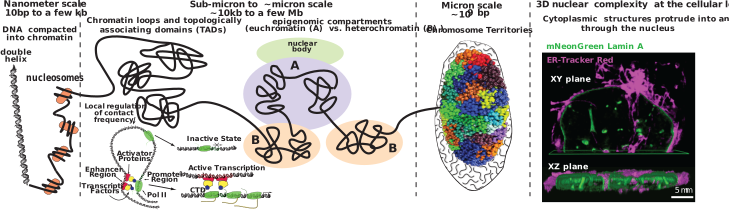
The 3D structure of the nucleus controls which genes are accessible to transcriptional machinery and how their regulatory elements interact across large genomic distances. Nuclear structure is complex at all levels
(Figure 1) and gene expression is not simply determined by the linear DNA sequence and local chromatin state. Gene expression is a function of a gene's position within the 3D nuclear space and its proximity to regulatory
elements and subnuclear compartments.
We know how genetic information is packaged and unpackaged, and have identified many of the regulatory proteins involved,
but are only now beginning to understand in detail how the spatial organization of the genome leads to rewiring of regulatory
networks during differentiation, cellular stress responses and disease initiation. Two general approaches have been used to
investigate chromosome spatial organization in the nucleus - Chromosome Conformation Capture (3C) methods and imaging using
DNA Fluorescent In Situ Hybridization (DNA-FISH) or genetic labeling methods.
FemtoSeq. My lab is developing a new image-correlated genomic technology we call Femto-Seq that retrieves high resolution DNA sequence information from targeted femtoliter volumes within the nucleus from a
relatively small number of user selected cells.

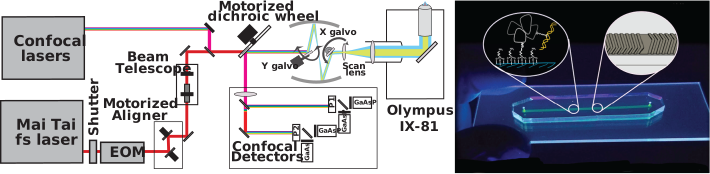
Femto-Seq combines imaging and genomics by using a photoactivatable DNA crosslinking and biotinylation probe that permeates into the nucleus and binds to DNA, where it is then activated using 3D localized two-photon (2P)
excitation. The use of 2P excitation confines the photo-biotinylation reaction to volumes that can be as small as ~0.1
femtoliters. The biotinylated DNA is pulled down and sequenced to provide information on the sequences contained within the
nanoscale region. The method works on live or fixed cells, and on tissue sections. The targeted regions can be sub-femtoliter
volumes around a specific gene locus, or any larger nuclear region of interest, such as the chromatin surrounding a nuclear body or chromatin near other nuclear structures. The only requirement is that some type of
fluorescent label needs to be used to mark the region-of-interest.
The method has some unique advantages over existing technologies:
(1) A major strength of femto-Seq is the ability to gather target specific sequence information from selected cells in a defined physiological, developmental or aberrant state. A user-selected subset of cells can be targeted for photo-biotinylation using real-time targeting and image analysis. The ability to select the specific cells from which we obtain sequence information from within a heterogenous cell population is unique and cannot be done using bulk biochemical methods.
(2) Femto-Seq can be used to uncover specific sequences within the selected nuclear volume around a gene locus
at high base pair resolution at less expense and in less time then 3C methods. If whole genome information is
needed, Femto-Seq is not applicable, however, to ask questions about the chromatin near a specific gene of interest
the method is ideal. For example, a series of experiments can be designed in which the collection volume around an activatable gene is changed from
the minimum possible (~0.1 femtoliters) through gradually increasing irradiation volumes to get a glimpse of variously scaled chromatin
environments around the gene. Using Femto-Seq we will be able to identify enhancers, nuclear protein condensate-forming sequences or other
regulatory sequences that may be near the transcription site. For investigations of a single gene locus our standard protocol is to collect
chromatin from (at least) two different spot sizes - a single spot with a volume of the two-photon point spread function (~106 base
pairs) and a larger region to normalize the spot sequences to, in order to quantify the enhancement of sequences in the sub-femtoliter
region.
(1) A major strength of femto-Seq is the ability to gather target specific sequence information from selected cells in a defined physiological, developmental or aberrant state. A user-selected subset of cells can be targeted for photo-biotinylation using real-time targeting and image analysis. The ability to select the specific cells from which we obtain sequence information from within a heterogenous cell population is unique and cannot be done using bulk biochemical methods.
(3) Using Femto-Seq previously impossible experiments can be carried out; for
example, we can collect DNA associated with nuclear bodies
such as nuclear speckles, which are dynamic, membrane-less organelles in the nucleus
that function as storage and recycling sites for
splicing factors, concentrating them and modulating splicing rates and enhancing
gene expression. Nuclear bodies appear to also play a
role in other types of RNA processing and have been linked to various diseases such
as cancer and viral infections. Finding sequences
located near and within these structures may reveal which protein factors are
involved based on the DNA binding sites uncovered.
(4) We are working on protocols to use Femto-Seq on FFPE sections, which could lead to its use in tumor
diagnostics. For example, FISH-stained cancer-associated genes in tumor cells could be targeted and information
on the local chromatin environment obtained. These types of investigations could lead to the
discovery of previously unknown enhancing elements in cancer.
We are currently optimizing the method and applying it to a number of different biological questions related to
gene regulation and nuclear structure. Instrumentation optimizations we are working on include construction of
a custom imaging/photoactivation system and microfluidics to increase the throughput of the isolation method.