Fluorescence Polarization Ratio Microscopy (FPRM)
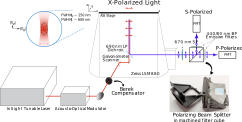
Using a simple modification of our two-photon microscopes, we have added the ability to perform a ratiometric form of
polariztion microscopy we call Fluorescence Polarization Ratiometric Microscopy (FPRM). This is a form of polarization
anisotropy, but instead of calculating the anisotropy (r) using the standard formula from fluorecence spectroscopy,
we just use the ratio of two polarization channels,
which provides a ratiometric measurement independent of fluorophore concentration and instrumental parameters.
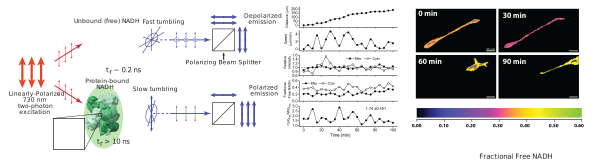
Our primary application for FPRM has been as a live-cell NADH imaging method that provides real-time information on the
fractional levels of unbound (free) NADH, which correlates directly with metabolic state (Ling et.al, in review Sci.Adv.).
FPRM of NADH has advantages over NADH-fluorescence lifetime imaging microscopy (FLIM), in that it is simple and inexpensive
to implement, and more than an order of magnitude faster. NADH-FPRM reduces the excitation dose compared to FLIM, minimizing cytotoxic stress and providing
high-resolution dynamic tracking of NADH signals with subcellular resolution. FPRM returns instrument-independent ratiometric
parameters that correlate with expected metabolic status during pharmaceutical and environmental perturbations.
FPRM reports on the relative mobility of the fluorophore which has been useful for other applications as well.
Examples include measurements of the level of chain-end immobilization of nanoengineered brush polymers
(Huang, et. al., Langmuir 2024, 40, 45, 24045-24061) and of molecular packing of florophores in protein condensates.